Gonna or Going To? Why I Correct My Students (Even Though “Gonna” Isn’t Wrong)
- James Batchelor

- Mar 18
- 3 min read
“James, can I say gonna?”
It’s one of the most common questions I hear as an English teacher in Vincennes. Students notice that native speakers don’t always sound like textbooks — especially if they’ve learned a lot of English through series, films, or YouTube.
My answer is always the same: yes, you can say gonna… but not yet.
This is where teaching becomes a balancing act between real-life English and solid foundations. Authentic speech matters, but accuracy matters first.
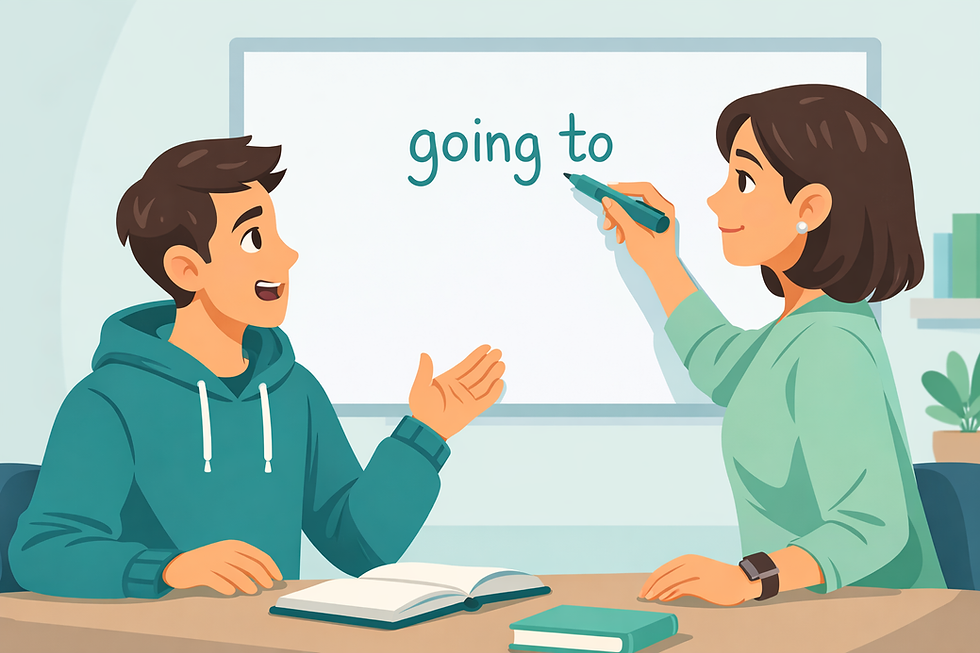
What “Going To” Actually Does
The structure be + going to + base verb expresses a planned future or an intention.
I am going to start a new project.
She is going to visit her family.
This form is essential in any English course in Vincennes because it appears constantly in exams, professional communication, and formal writing. Unlike spontaneous future forms such as will, it signals preparation and prior decision.
More importantly, it forces learners to control the auxiliary verb be, which is one of the biggest challenges for French speakers.
Without this foundation, many sentences collapse grammatically.
What “Gonna” Really Is (and Isn’t)
“Gonna” is not a new tense. It is not a different grammar rule. It is simply how going to often sounds in fast, informal speech.
Native speakers reduce sounds constantly. In online education and E-learning materials based on authentic dialogue, you’ll hear reductions everywhere because they reflect natural pronunciation.
However, learners often treat gonna as a vocabulary item rather than a pronunciation phenomenon. That’s where problems begin.
Students may write it in formal contexts, drop the auxiliary (I gonna go), or use it mechanically without understanding the underlying structure.
Why I Correct It
Correction is not about policing language. It’s about sequencing learning.
In private tutoring in English, I frequently see how early shortcuts become permanent habits. Linguists call this fossilization — errors that stop improving because they have become automatic.
By insisting on going to, I help students:
Master the auxiliary be
Maintain grammatical clarity
Build forms that work in all contexts
Avoid confusing pronunciation with spelling
Once the structure is automatic, flexibility becomes possible.
Other Common Informal Reductions (Often Learned from TV)
“Gonna” is only the beginning. Students who learn heavily from entertainment often bring a whole package of informal forms:
wanna (want to)
gotta (have got to / must)
lemme (let me)
kinda (kind of)
sorta (sort of)
These are not really slang in the traditional sense. They are reductions — compressed
pronunciation in casual speech.
The problem is not that students use them. The problem is that they may not fully control the standard form behind them.
Knowing the real term going to is essential for several reasons.
First, in professional situations, reduced forms can sound careless or immature. A job interview, presentation, or formal email is not the place for “gonna.”
Second, clarity matters. Not everyone understands reduced speech easily, especially in international environments where English is a lingua franca.
When learners follow an English course with CPF, many are preparing for workplace communication. In those contexts, precision is often more valuable than sounding “native-like.”
When Informal Forms Become Appropriate
Once the grammar is solid, informal reductions become tools rather than risks.
They help with:
Understanding native speakers
Participating in relaxed conversations
Sounding less rigid and more natural
Adapting to different social contexts
In an English course with CPF in Vincennes, advanced learners often work specifically on register — choosing how formal or informal to be depending on the situation.
True fluency is not speaking casually all the time. It is choosing the right level of language for the moment.
Classroom Activities That Build This Skill
Developing this flexibility requires deliberate practice.
I often use activities such as:
Transforming formal sentences into informal spoken versions
Listening exercises with authentic dialogue
Role-plays across different contexts (friends vs workplace)
Error-detection tasks
Interestingly, students who also take private tutoring in French recognize the same phenomenon in reverse: spoken French also compresses sounds dramatically.
Register awareness is a universal language skill, not an English problem.
Final Thoughts: Correction as Support, Not Restriction
“Gonna” is not wrong. It is simply advanced.
Language mastery is not about avoiding informal speech — it is about earning the ability to use it well.
As a French teacher in Vincennes as well, I see how learners progress fastest when they build strong structures first and stylistic variation second.
So if I correct you when you say gonna, it’s not because I want you to sound like a textbook.
It’s because I want you to have the freedom to sound however you choose — formal, informal, professional, or relaxed — without ever losing clarity or control.
And that freedom begins with two small words: going to.


Comments